
Saudi VAT Basics: A Plain Guide for Business Owners (2026)
By Vikn Codes Published
Saudi VAT in one place: the 15% rate, who must register, zero-rated and exempt supplies, tax invoices, returns, penalties, and the fines waiver that runs until 31 December 2026.
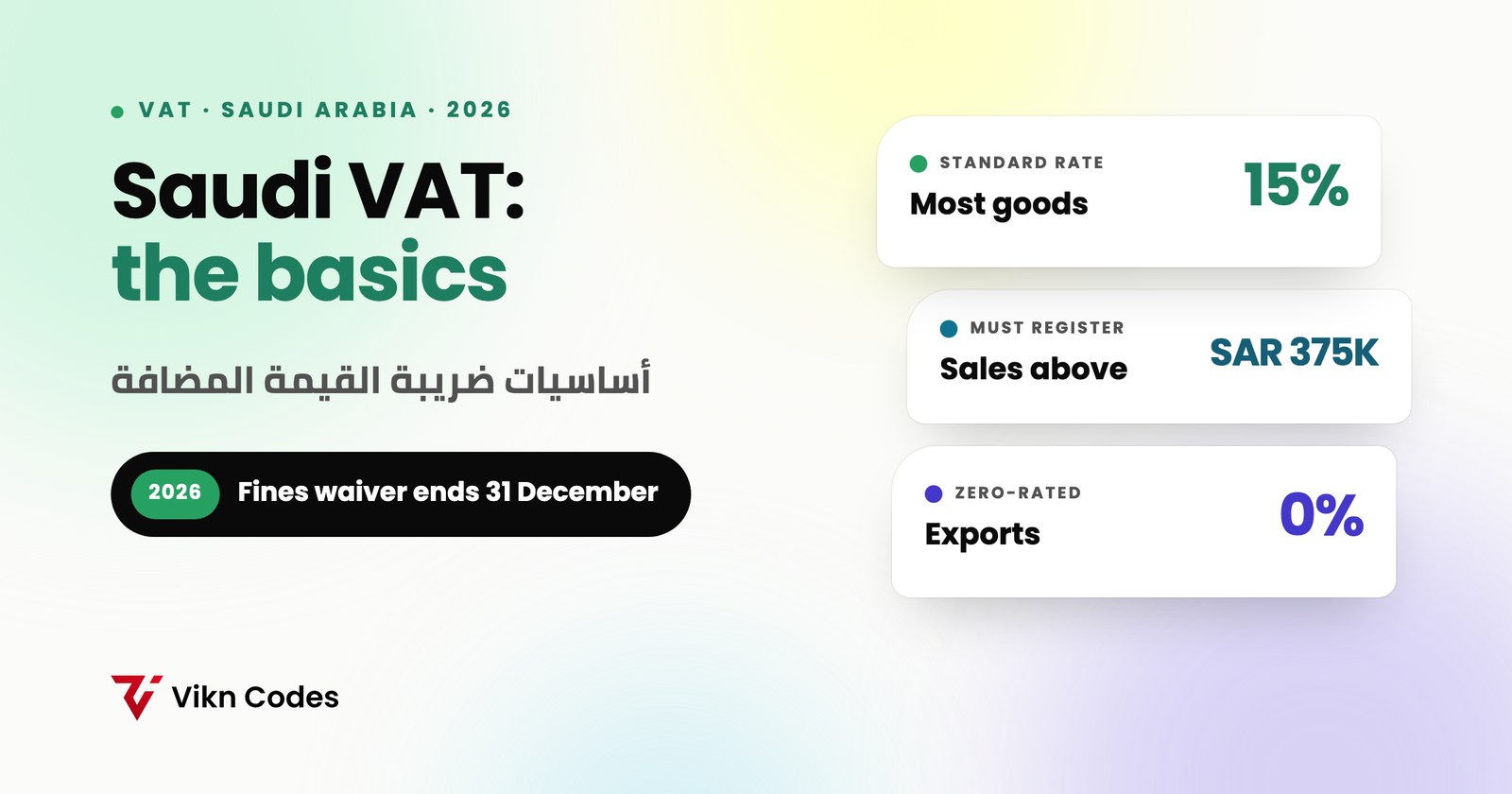
Value Added Tax (VAT) has applied in Saudi Arabia since 1 January 2018, and the rate has been 15% since 1 July 2020. It is run by the Zakat, Tax and Customs Authority (ZATCA).
If you sell goods or services in the Kingdom, VAT affects your prices, your invoices and your cash flow. This guide covers the basics every business owner should know.
Saudi VAT at a glance
| Standard rate | 15% |
| Must register | Taxable sales above SAR 375,000 in 12 months |
| Can register | From SAR 187,500 |
| Returns | Monthly if sales are above SAR 40 million a year, otherwise quarterly |
| Return and payment due | Last day of the month after the period ends |
| Invoices | Electronic invoices are mandatory (ZATCA e-invoicing) |
| Keep records for | At least 6 years |
How VAT works
VAT is charged at each step from supplier to customer, but only the final consumer really bears it:
- You add 15% VAT to your sales and collect it from customers (output VAT).
- You pay 15% VAT on your business purchases (input VAT).
- Each period you pay ZATCA the difference, or claim a refund if your input VAT is higher.
Example: you sell goods for SAR 10,000 plus SAR 1,500 VAT, and you bought stock for SAR 6,000 plus SAR 900 VAT. You pay ZATCA SAR 1,500 − SAR 900 = SAR 600.
Do you need to register?
- Mandatory: when your taxable sales go above SAR 375,000 in the past 12 months, or are expected to in the next 12 months. Apply on the ZATCA portal as soon as you cross the limit.
- Voluntary: if your sales or expenses are above SAR 187,500. Registering early lets you recover VAT on your purchases and can make you look more established to business customers.
- Non-residents that make taxable supplies in Saudi Arabia must register regardless of turnover.
Late registration carries a fine of SAR 10,000.
What is taxed, zero-rated or exempt
| Treatment | What it means | Common examples |
|---|---|---|
| Standard (15%) | Charge 15%, recover input VAT | Most goods and services |
| Zero-rated (0%) | Charge 0%, but still recover input VAT | Exports outside the GCC, international transport, qualifying medicines and medical equipment, investment gold, silver and platinum |
| Exempt | Charge no VAT and do not recover the related input VAT | Most residential rent, certain financial services such as interest margins, life insurance |
Sales of real estate generally fall under the separate Real Estate Transaction Tax (RETT) at 5% instead of VAT.
Tax invoices
Every invoice must be issued from a compliant electronic system, in Arabic (other languages can be added alongside).
- Standard tax invoice: for sales to other businesses. It shows both your VAT number and the buyer's VAT number.
- Simplified tax invoice: for sales to consumers, with a QR code.
- Credit and debit notes: to correct or cancel an invoice. You must never edit or delete an invoice after issuing it.
Most businesses are now also being connected to ZATCA's Fatoora platform in waves. Businesses with sales above SAR 187,500 must be connected by 1 February 2027; see our ZATCA e-invoicing guide.
Claiming input VAT
You can recover VAT you paid on purchases used for your taxable business, as long as you hold a valid tax invoice in your business name. VAT on some costs is blocked and cannot be recovered, including entertainment and hospitality and most passenger cars used privately. Check the rules before claiming.
Returns and payment
- Monthly returns are required if annual taxable sales are above SAR 40 million; everyone else files quarterly.
- File the return and pay the tax by the last day of the following month (for example, the January–March quarter is due by 30 April).
- File a return even if you had no sales in the period.
Penalties
| Violation | Penalty |
|---|---|
| Late registration | SAR 10,000 |
| Late filing of a return | 5% to 25% of the tax due |
| Late payment | 5% of the unpaid tax for each month or part of a month |
| Incorrect return that understates the tax | 50% of the difference |
| Not issuing invoices or not keeping records | Up to SAR 50,000 |
The fines waiver ends on 31 December 2026
ZATCA's Cancellation of Fines and Exemption of Financial Penalties initiative has been extended to 31 December 2026. It can cancel fines for late registration, late filing, late payment and corrections of VAT returns. To qualify you must be registered, file all outstanding returns and pay the original tax due (an instalment plan can be requested). It does not cover tax evasion, and it applies only to returns that were due on or before 30 June 2026.
If you have old fines, this is the time to clear them.
Your VAT checklist
- Track your sales every month against the SAR 375,000 limit.
- Set the right VAT treatment (15%, 0% or exempt) for each product and service in your billing system.
- Check every purchase invoice shows your business name and VAT number before you claim the VAT.
- Fix mistakes with credit or debit notes, never by editing an invoice.
- File and pay on time, even for nil returns.
- Keep your records for at least six years.
- Get your e-invoicing ready for your Fatoora wave.
How Vikn Codes can help
Vikn Codes builds accounting software (Viknbooks and Vikn ERP), retail POS and restaurant POS (Rassasy) for Saudi businesses, with VAT invoices, VAT reports and ZATCA Phase 2 e-invoicing built in. Our team in Jizan, Jeddah and Riyadh helps you set up and stay compliant.
Book a free demo to see how it works for your business.
For a side-by-side comparison with the UAE and India, read VAT in Saudi Arabia and the UAE, GST in India.
This article is general guidance, last updated October 2026. VAT rules, penalties and initiatives change, so always confirm the details for your business on zatca.gov.sa or with your tax adviser.