
ZATCA E-Invoicing in Saudi Arabia: What Every Business Needs to Know in 2026
By Vikn Codes Published
Wave 25 of ZATCA's e-invoicing rollout brings businesses with more than SAR 187,500 in annual sales into Phase 2 by 1 February 2027. Here is what Phase 1 and Phase 2 mean, who has to comply, and how to get ready.
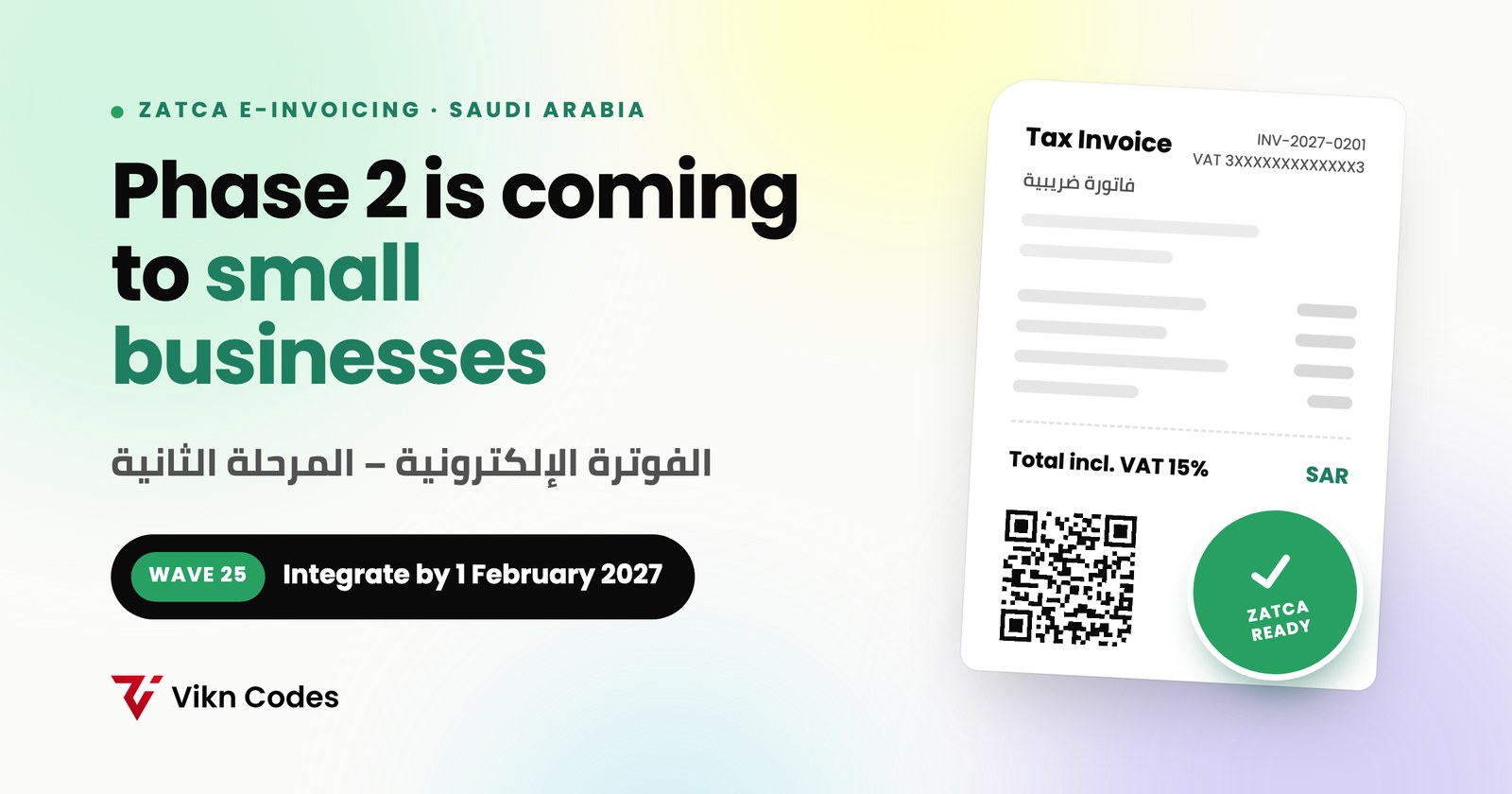
Since December 2021, every VAT-registered business in Saudi Arabia has had to issue its invoices electronically. The Zakat, Tax and Customs Authority (ZATCA) is now connecting businesses to its Fatoora platform wave by wave, and the latest wave reaches deep into small business.
On 24 July 2026, ZATCA announced Wave 25: businesses whose VAT-taxable revenue went above SAR 187,500 in any year from 2022 to 2025 must be integrated with Fatoora by 1 February 2027. That covers many cafés, shops, boutiques, workshops and service providers for the first time.
This guide explains what e-invoicing means, what changes in each phase and what you need to do before your deadline.
What is ZATCA e-invoicing?
E-invoicing (Fatoora) means creating, sending and storing invoices in a structured electronic format through a compliant system, instead of handwritten books, Word or Excel files. Every invoice carries data that ZATCA can read and check, which reduces errors and tax evasion.
The rollout has two phases.
Phase 1: Generation (since 4 December 2021)
Phase 1 applies to all VAT-registered businesses. You must:
- Issue invoices and credit/debit notes from a compliant electronic system.
- Include all the required fields, with the invoice in Arabic (other languages can be added alongside).
- Print a QR code on simplified (B2C) invoices.
- Stop using handwritten invoices or editable documents such as Word or Excel.
- Make sure invoices cannot be changed or deleted after they are issued.
Phase 2: Integration (in waves since 1 January 2023)
Phase 2 connects your invoicing system directly to ZATCA. On top of Phase 1, each invoice must:
- Be generated in XML format (UBL 2.1), optionally with a PDF/A-3 copy for the customer.
- Carry a cryptographic stamp, a unique ID (UUID) and the hash of the previous invoice, so the chain cannot be tampered with.
- Be sent to ZATCA through the Fatoora API.
Each device or system that issues invoices must also be onboarded on the Fatoora portal before it can send invoices.
Standard vs simplified invoices
| Standard tax invoice | Simplified tax invoice | |
|---|---|---|
| Used for | Business to business (B2B) and government (B2G) | Business to consumer (B2C), e.g. retail and restaurants |
| Buyer's VAT number | Required | Not required |
| QR code | Optional | Required |
| Phase 2 process | Clearance: ZATCA must approve the invoice before you share it with the buyer | Reporting: you give the invoice to the customer, then report it to ZATCA within 24 hours |
Who has to integrate, and when?
ZATCA brings businesses into Phase 2 in waves based on their VAT-taxable revenue, and notifies each business in a wave in advance. The most recent waves are:
| Wave | VAT-taxable revenue above | Revenue years checked | Integration deadline |
|---|---|---|---|
| 23 | SAR 750,000 | 2022–2024 | 31 March 2026 |
| 24 | SAR 375,000 | 2022–2024 | 30 June 2026 |
| 25 | SAR 187,500 | 2022–2025 | 1 February 2027 |
If your sales passed SAR 187,500 in any one of those years, assume you are in scope. Check your ZATCA portal account and email for the official notification.
What happens if you do not comply?
ZATCA applies penalties that usually start with a warning and grow with each repeat. Violations include not issuing e-invoices, issuing invoices without the QR code, changing or deleting invoices after they are issued, and not integrating by your deadline. Fines can reach SAR 50,000 per violation for serious or repeated cases, so it pays to be ready early.
Your Phase 2 checklist
- Confirm your wave. Check your revenue for 2022–2025 and look for ZATCA's notification.
- Choose a compliant solution. Use invoicing, POS or accounting software that supports Phase 2, ideally one listed in ZATCA's directory of e-invoicing solution providers.
- Clean up your data. Your VAT number, commercial registration, address and customer VAT numbers must be correct, because ZATCA validates them.
- Onboard every device. Generate an OTP on the Fatoora portal and register each POS counter, branch or system that issues invoices.
- Test before go-live. Send test invoices, credit notes and returns and confirm they are cleared or reported without errors.
- Train your team. Cashiers and accountants should know how to issue credit notes instead of editing invoices, and what to do if the internet goes down.
- Keep your records. Store your e-invoices safely for the period VAT law requires.
How Vikn Codes can help
Vikn Codes builds ZATCA Phase 2 ready software for Saudi businesses of every size:
- Retail POS for supermarkets and shops, with fast barcode billing and QR-coded invoices.
- Restaurant POS (Rassasy) for restaurants and cafés, with a kitchen display.
- Accounting software (Viknbooks and Vikn ERP) with VAT reports and e-invoicing built in.
Invoices are issued in the Phase 2 format and sent to ZATCA automatically, and our team in Saudi Arabia helps you onboard and go live before your deadline.
Is your business in Wave 25? Book a free demo and we will help you get ready well before 1 February 2027.
This article is general guidance, last updated October 2026. ZATCA can change its rules and deadlines, so always confirm the details for your business on the official ZATCA website or with your tax adviser.