
VAT in Saudi Arabia and the UAE, GST in India: A 2026 Guide for Business Owners
By Vikn Codes Published
Rates, registration limits, returns and e-invoicing deadlines for Saudi VAT, UAE VAT and Indian GST, side by side, for businesses that trade in one country or across all three.
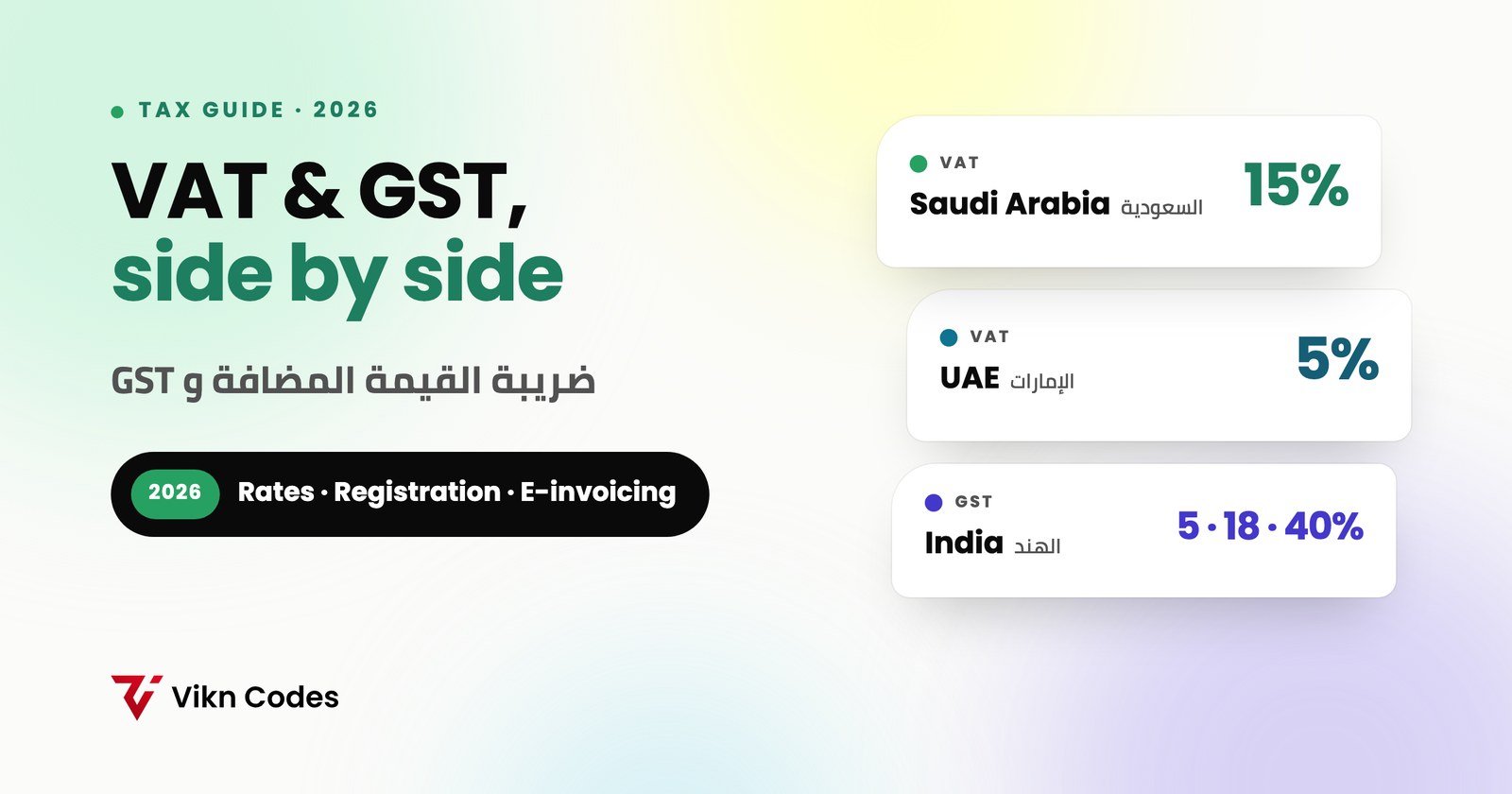
Saudi Arabia and the UAE charge VAT, and India charges GST. Both are taxes on consumption: you collect them from customers on each sale, subtract the tax you paid on your own purchases, and pay the difference to the government.
The idea is the same in all three countries, but the rates, limits and paperwork are not. This guide puts them side by side so you know what applies to your business in 2026.
At a glance
| Saudi Arabia | UAE | India | |
|---|---|---|---|
| Tax | VAT | VAT | GST (CGST + SGST, or IGST) |
| Authority | ZATCA | Federal Tax Authority (FTA) | GST Council / GSTN |
| Standard rate | 15% | 5% | 18% (also 5% and 40%) |
| Must register above | SAR 375,000 a year | AED 375,000 a year | ₹40 lakh (goods), ₹20 lakh (services) |
| Can register from | SAR 187,500 | AED 187,500 | Any turnover |
| E-invoicing | Mandatory, Phase 2 in waves | Starts 1 January 2027 | Above ₹5 crore turnover |
VAT in Saudi Arabia
- Rate: 15% on most goods and services since 1 July 2020. Some supplies, such as exports and certain medicines, are zero-rated, and some, such as most residential rent, are exempt.
- Registration: mandatory when taxable sales go above SAR 375,000 in 12 months; voluntary from SAR 187,500.
- Returns: monthly if annual sales are above SAR 40 million, otherwise quarterly. Each return and payment is due by the last day of the following month.
- E-invoicing: every VAT-registered business must issue electronic invoices. Phase 2, which connects your billing system to ZATCA's Fatoora platform, is rolling out in waves. The latest, Wave 25, covers businesses with sales above SAR 187,500 and must be done by 1 February 2027. Read our ZATCA e-invoicing guide for the details.
VAT in the UAE
- Rate: 5% since 1 January 2018, with zero-rating for exports, international transport and some education and healthcare, and exemptions such as residential rent and local passenger transport.
- Registration: mandatory when taxable supplies and imports go above AED 375,000 in the past 12 months, or are expected to in the next 30 days; voluntary from AED 187,500.
- Returns: usually quarterly (monthly for some larger businesses). Returns and payment are due by the 28th day after the period ends.
- Penalties: a new penalty system started on 14 April 2026. It replaces compounding fines with a fixed yearly rate for late payment and lower, fixed penalties for errors you correct yourself through a voluntary disclosure.
- E-invoicing is coming: the UAE is moving to e-invoicing for business-to-business and business-to-government sales through accredited service providers (ASPs):
| Business | Appoint an ASP by | E-invoicing mandatory from |
|---|---|---|
| Revenue of AED 50 million or more | 30 October 2026 | 1 January 2027 |
| Other businesses in scope | 31 March 2027 | 1 July 2027 |
If you sell only to consumers (B2C), these first phases do not apply to you yet.
GST in India
- Rates: since 22 September 2025 (often called GST 2.0), most goods and services fall into two slabs, 5% and 18%, with 40% for luxury and "sin" goods such as tobacco and aerated drinks, and nil rate for essentials such as unbranded staples. The old 12% and 28% slabs are gone.
- Structure: a sale within one state carries CGST + SGST (split equally); a sale to another state carries IGST.
- Registration: mandatory above ₹40 lakh turnover for goods and ₹20 lakh for services (lower limits apply in some special category states), and in some cases from the first sale, such as interstate supplies of goods or selling through e-commerce platforms.
- Returns: GSTR-1 for sales and GSTR-3B for the tax summary, monthly or quarterly under the QRMP scheme for smaller taxpayers.
- E-invoicing: mandatory if your turnover has been above ₹5 crore in any year since 2017-18. Each invoice is registered on the Invoice Registration Portal (IRP) and gets an IRN and QR code. If your turnover is ₹10 crore or more, you must report invoices to the IRP within 30 days, or they cannot be registered.
Five mistakes we see most often
- Registering late. The limit is measured over rolling 12 months, not the calendar year. Watch your sales every month once you get close.
- Using the wrong rate. India's rates changed in September 2025, and many price lists and product masters still carry the old 12% or 28%.
- Claiming tax you cannot recover. Input tax needs a valid tax invoice in your name, and in India the supplier must also have filed it so it shows in your GSTR-2B.
- Editing invoices after they are issued. In Saudi Arabia and India, a mistake is fixed with a credit or debit note, never by changing or deleting the invoice.
- Leaving e-invoicing to the last month. Onboarding, testing and training take weeks, and the deadlines in Saudi Arabia and the UAE are close.
How Vikn Codes can help
Vikn Codes builds billing, POS and accounting software used by businesses in India, Saudi Arabia, the UAE and Oman:
- Accounting software (Viknbooks and Vikn ERP) with VAT and GST invoices, tax reports and multi-branch accounts.
- Retail POS and Restaurant POS (Rassasy) with fast billing and tax-ready receipts.
- ZATCA Phase 2 e-invoicing built in for Saudi Arabia.
Not sure which rules apply to you, or trading across more than one country? Book a free demo and our teams in India and the Gulf will walk you through it.
This article is general guidance, last updated October 2026. Tax rules, rates and deadlines change, so always confirm the details for your business with ZATCA, the UAE FTA, the GST portal or your tax adviser.