
GST 2.0 in India: New Rates and the 2026 Rules Every Business Should Know
By Vikn Codes Published
India's GST now has two main rates, 5% and 18%, plus 40% for luxury and sin goods. Here is what changed, which 2026 compliance rules affect you, and a checklist to keep your billing and returns right.
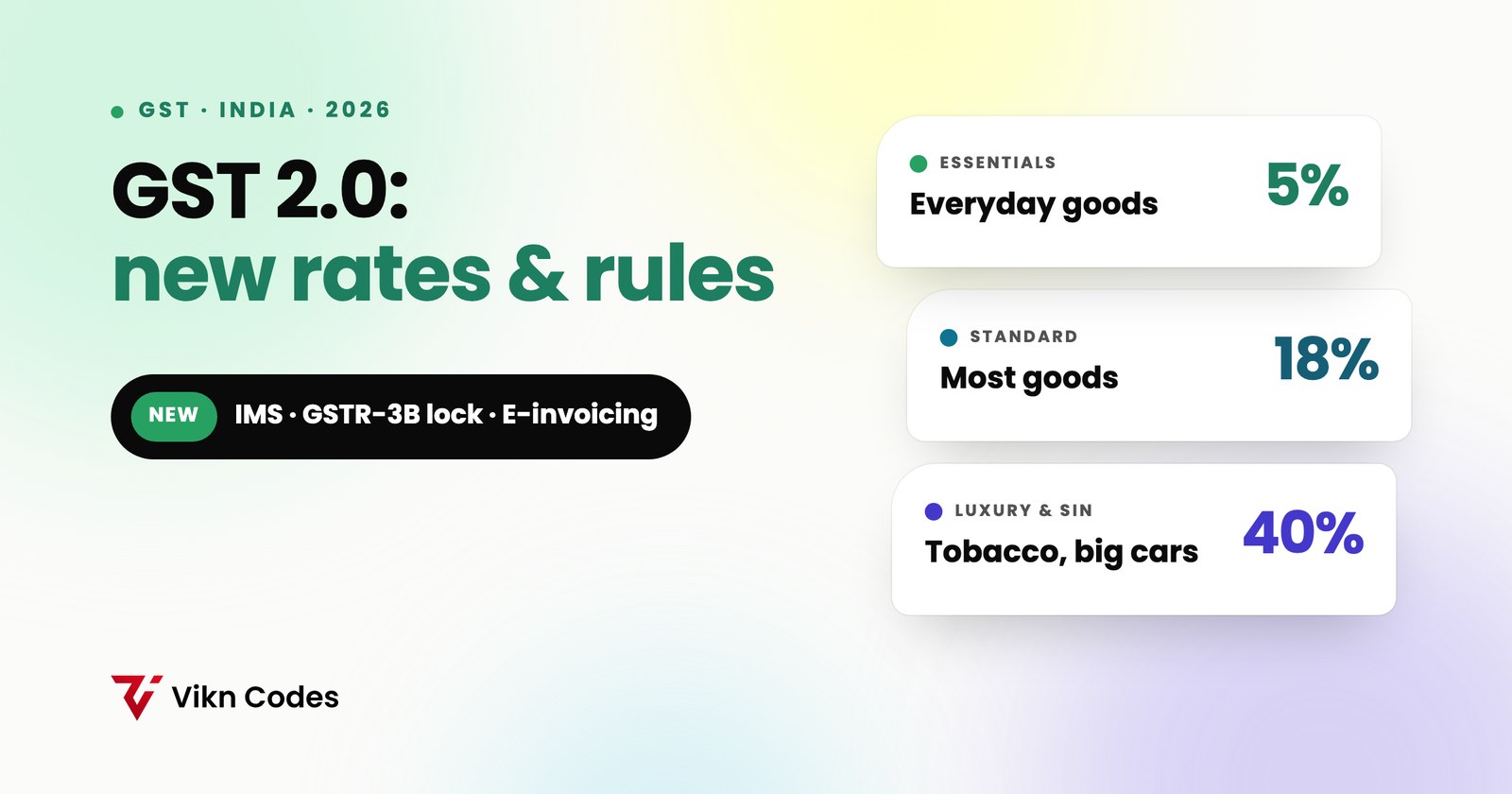
On 22 September 2025, India made the biggest change to GST since it was launched in 2017. The four main rates of 5%, 12%, 18% and 28% became two main rates, 5% and 18%, with a special 40% rate for luxury and "sin" goods. Most people call it GST 2.0.
Since then, several new compliance rules have also come into force. If your billing software, price lists or monthly routine still follow the old system, you may be charging the wrong tax or losing input tax credit. This guide covers what changed and what to check.
The new GST rates
| Rate | What it covers (examples) |
|---|---|
| Nil | Unbranded essentials such as fresh milk and fresh vegetables, individual life and health insurance, and many lifesaving medicines |
| 5% | Everyday goods such as toothpaste, soap, hair oil and shampoo, many packaged foods, bicycles, most medicines, restaurant services (without input tax credit) and hotel rooms up to ₹7,500 a night |
| 18% | Most goods and services, including electronics, air conditioners, TVs, cement, small cars and motorcycles up to 350cc, and professional and IT services |
| 40% | Luxury and sin goods such as aerated and sugary drinks, large cars, motorcycles above 350cc, and tobacco and pan masala |
The old 12% and 28% slabs are gone. Most items that were at 12% moved down to 5%, and most items at 28% moved down to 18%. Always check the exact rate for your products by their HSN or SAC code, because there are exceptions.
What else changed with GST 2.0
- Compensation cess has ended. Tobacco and pan masala moved to the 40% rate on 1 February 2026, when the compensation cess was replaced by separate excise and health cess levies outside GST.
- No input tax credit reversal for rate cuts. If your product moved to a lower rate but is still taxable, you do not have to reverse the credit you already took. Reversal applies only if a supply became fully exempt.
- Prices should reflect the lower tax. Rate cuts were meant to reach customers, so update your MRP labels, price lists and quotations.
Compliance rules to know in 2026
- Invoice Management System (IMS). Every invoice your suppliers upload appears in IMS, where you accept, reject or keep pending each one. Only accepted invoices flow into your GSTR-2B, so this is now part of the monthly routine for regular taxpayers.
- GSTR-3B is auto-filled and locked. Your GSTR-3B is filled from your GSTR-1 and IMS data, and the auto-filled tax liability can no longer be edited after filing. Fix mistakes in GSTR-1 (or GSTR-1A) before you file.
- Three-year limit on returns. Returns that are more than three years past their due date can no longer be filed on the portal.
- Multi-factor authentication. Logging in to generate e-invoices and e-way bills needs a one-time password as well as your password.
Registration and returns at a glance
| Rule | |
|---|---|
| Registration (goods) | Mandatory above ₹40 lakh turnover (₹20 lakh in some special category states) |
| Registration (services) | Mandatory above ₹20 lakh turnover (₹10 lakh in some special category states) |
| Always register | Interstate supply of goods, selling through e-commerce platforms, and some other cases, regardless of turnover |
| Composition scheme | Optional for small businesses up to ₹1.5 crore (goods) or ₹50 lakh (services); pay a fixed low rate but you cannot claim input tax credit or collect GST from customers |
| Monthly returns | GSTR-1 (sales) by the 11th and GSTR-3B (summary and payment) by the 20th |
| Quarterly option | The QRMP scheme for turnover up to ₹5 crore: quarterly returns with monthly tax payment |
E-invoicing
E-invoicing applies if your turnover has been above ₹5 crore in any financial year since 2017-18. Each B2B invoice is uploaded to the Invoice Registration Portal (IRP), which returns an IRN and a signed QR code that must be printed on the invoice. If your turnover is ₹10 crore or more, invoices must be reported within 30 days of the invoice date, or the IRP will not accept them.
Your GST 2.0 checklist
- Update every item's GST rate in your billing or POS software, using the HSN or SAC code. Remove any 12% or 28% rates still in your item master.
- Reprint price tags and update price lists so customers see the lower tax where it applies.
- Check your restaurant or hotel settings. Restaurant services are 5% without input tax credit; hotel rooms up to ₹7,500 a night are 5%.
- Review IMS every month before filing GSTR-3B, and follow up with suppliers whose invoices are missing.
- Get GSTR-1 right first, because GSTR-3B now follows it and cannot be changed afterwards.
- Clear any old pending returns before they pass the three-year limit.
- Watch your turnover against the registration, composition, QRMP and e-invoicing limits.
How Vikn Codes can help
Vikn Codes is based in Kozhikode, Kerala, and builds billing and accounting software used by businesses across India and the Gulf:
- Accounting software (Viknbooks and Vikn ERP) with GST invoices, HSN-wise tax setup, GSTR reports and multi-branch accounts.
- Retail POS and Restaurant POS (Rassasy) with fast billing and GST-ready receipts.
Need help moving your item master to the new rates or getting your GST reports right? Book a free demo and our team in India will walk you through it.
Comparing India with the Gulf? Read our guide to VAT in Saudi Arabia and the UAE, and GST in India.
This article is general guidance, last updated October 2026. GST rates, notifications and portal rules change often, so always confirm the rate for your products and the rules for your business on the GST portal or with your chartered accountant.