
UAE E-Invoicing 2026: Deadlines, Penalties and How to Get Ready
By Vikn Codes Published
The UAE's e-invoicing system starts on 1 January 2027, and large businesses must appoint an Accredited Service Provider by 30 October 2026. Here is who is in scope, how the system works, what the fines are and a step-by-step plan.
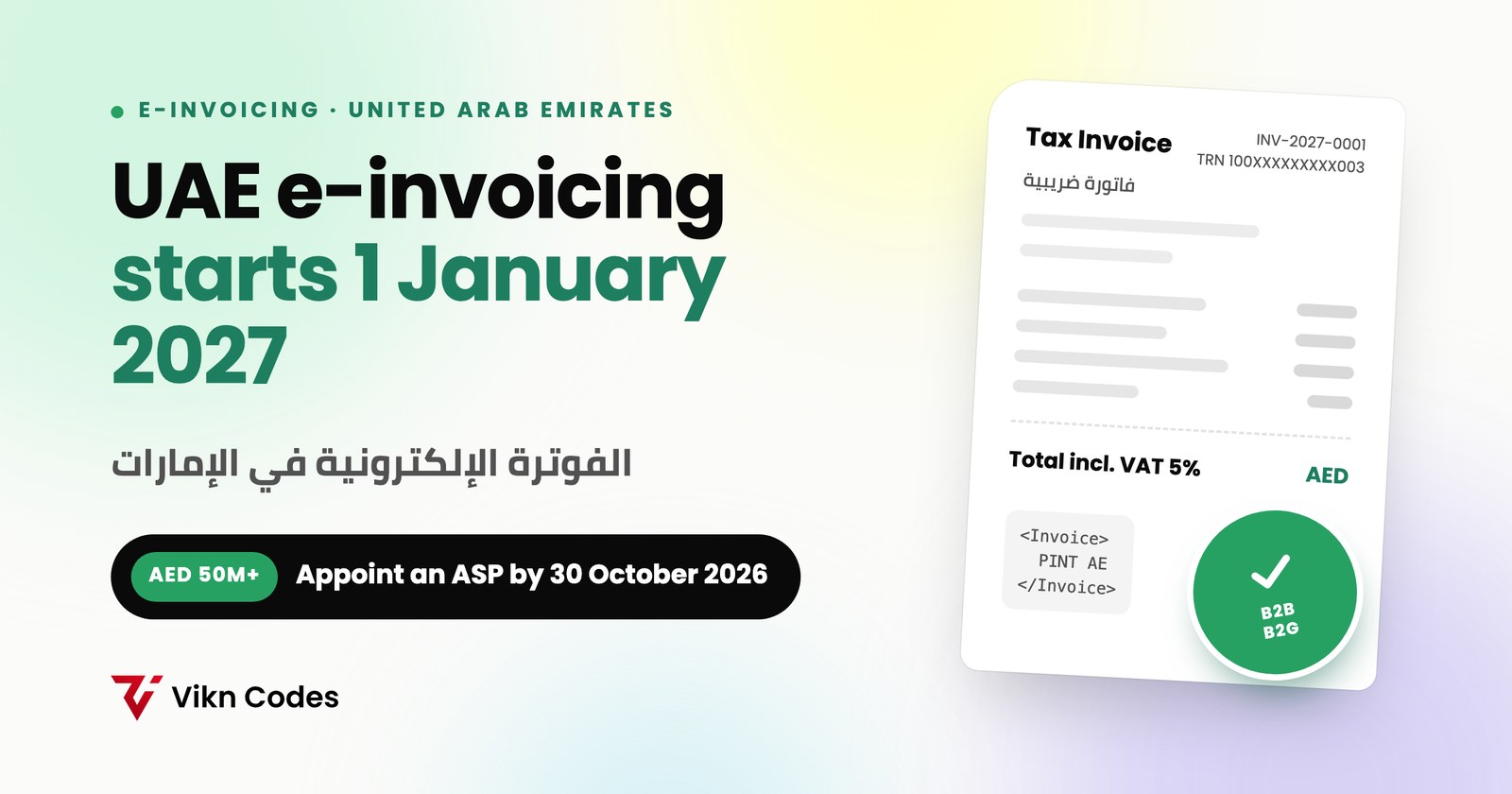
The UAE is replacing PDF and paper invoices between businesses with structured electronic invoices that are exchanged through accredited providers and reported to the Federal Tax Authority (FTA) in near real time.
The first deadline is close. If your business has revenue of AED 50 million or more, you must appoint an Accredited Service Provider (ASP) by 30 October 2026 and start issuing e-invoices on 1 January 2027. The Ministry of Finance moved the ASP deadline from 31 July 2026 to 30 October 2026 in May 2026, but the go-live date did not change.
Key dates
| Who | Appoint an ASP by | E-invoicing mandatory from |
|---|---|---|
| Businesses with revenue of AED 50 million or more | 30 October 2026 | 1 January 2027 |
| Businesses with revenue below AED 50 million | 31 March 2027 | 1 July 2027 |
| Government entities | 31 March 2027 | 1 October 2027 |
A voluntary pilot has been open since July 2026 for businesses that want to start early.
Who has to comply?
E-invoicing applies to business-to-business (B2B) and business-to-government (B2G) transactions by businesses operating in the UAE, including non-residents with UAE transactions. It applies to the invoices you send and the invoices you receive, so even a business that mostly buys will need an ASP to receive e-invoices from its suppliers.
Not in scope for now:
- Business-to-consumer (B2C) sales. Retailers and restaurants that sell only to consumers do not have to comply until the Ministry sets a later date.
- Certain specific activities, such as sovereign government activities, some international airline services and exempt or zero-rated financial services.
How UAE e-invoicing works
The UAE uses a five-corner model built on the international Peppol network:
- You (the supplier) create the invoice in your accounting or ERP system.
- Your ASP converts it to the UAE format, validates it and sends it over Peppol.
- Your customer's ASP receives it.
- Your customer gets it straight into their system.
- The FTA receives the tax data from the ASPs at the same time.
Invoices are exchanged in a structured XML format based on the PINT AE standard (Peppol BIS Billing 3.0). A PDF sent by email will no longer count as a tax invoice for in-scope transactions. Credit notes go through the same route.
What does an ASP do?
An Accredited Service Provider is a company approved by the Ministry of Finance to connect businesses to the e-invoicing network. The ministry publishes the official list on its website. Your ASP:
- converts and validates your invoices,
- sends and receives e-invoices on your behalf,
- reports the tax data to the FTA.
When choosing one, check that it connects easily to your accounting or ERP software, how it charges (per invoice or flat fee), what support it offers in your time zone, and how quickly it can onboard you before your deadline.
Penalties
The fines are set out in Cabinet Decision No. 106 of 2025:
| Violation | Penalty |
|---|---|
| Not implementing e-invoicing or not appointing an ASP by your deadline | AED 5,000 for each month |
| Not issuing an invoice or credit note in the e-invoicing format | AED 100 per document, up to AED 5,000 a month |
| Not telling the FTA about a system failure that stops e-invoicing | AED 1,000 per day |
| Not updating your ASP when your registration or master data changes | AED 1,000 per day |
Your readiness checklist
- Confirm your phase. Check whether your revenue is above or below AED 50 million.
- Shortlist and appoint an ASP from the Ministry of Finance list, well before your deadline.
- Clean up your master data. Your TRN, legal name and address, plus the TRNs and details of every business customer and supplier, must be correct, because the ASP validates them.
- Check your invoices. Make sure your system can produce every field the UAE format needs, including tax category codes and units of measure.
- Connect and test. Link your accounting or ERP system to the ASP and send test invoices, credit notes and returns.
- Prepare to receive. Set up how e-invoices from suppliers will flow into your purchases and approvals.
- Train your team and agree on what to do if the system goes down, including notifying the FTA.
How Vikn Codes can help
Vikn Codes builds accounting software (Viknbooks and Vikn ERP) and POS systems used by businesses across the UAE and the Gulf, with VAT invoices and reports built in. Our UAE team can help you review your invoice data, clean up customer and supplier records and plan the move to e-invoicing.
Is your business in Phase 1? Talk to us now, so you are ready well before 1 January 2027.
This article is general guidance, last updated October 2026. The Ministry of Finance and the FTA may change the rules and deadlines, so always confirm the details for your business on mof.gov.ae, tax.gov.ae or with your tax adviser.